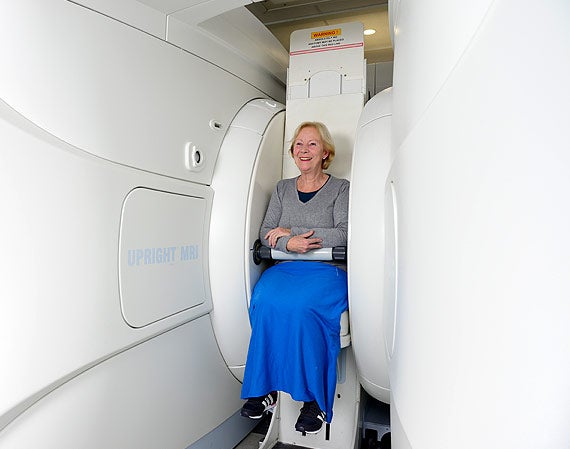
Our Open MRI Scanner
Experience the latest in patient-friendly MRI with an upright and open MRI scanner at our Medserena centres London MRI and Manchester MRI.
Our scanner offers both upright and open MRI in one system, designed for maximum comfort and diagnostic versatility.
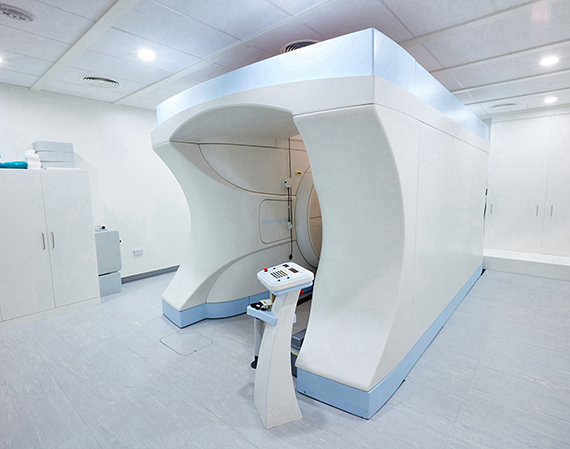
What Makes Our Scanner Unique
Patient-centric design
Unlike traditional tunnel-based MRI machines, ours is open at the front and allows you to be scanned in the position you find most comfortable — sitting, standing, or inclined.
Ideal for everyone
Suitable for patients with claustrophobia, mobility challenges, for those who cannot lie flat for long periods, and those requiring a dynamic weight-bearing scan.
Our Upright MRI Scanner Explained
The upright MRI allows imaging in weight-bearing positions such as sitting, standing, or inclined, and even flexion or extension of the spine. This enables clinicians to see anatomy and affected areas as they are in everyday life, especially useful for diagnosing conditions that change with position or under weightbearing. Scans can be performed while standing or sitting (depending on examination type), revealing more than conventional supine MRIs.
Scan positions available
- Standing
- Sitting
- Inclined
- Flexion, extension, and rotation
Weight-bearing imaging
This unique feature shows how gravity and posture affect the joints and spine.
IntelligentMR
IntelligentMR recent technology that increases image quality while decreasing the time you need to spend in the MRI.
Dimensions and Patient Limits
- Width between magnet poles: The patient gap is 46 cm (18 inches) from pole to pole, which determines the maximum width the patient can occupy during scanning.
- Weight limit: The Fonar Upright MRI can accommodate patients weighing up to 227 kg (226 stone), making it suitable for most individuals, including many larger patients. This is limited by individual body shape and area being scanned, so we may not always be able to accommodate the upper end of this range.
- Open design: The front and top of the scanner are both open, enhancing comfort for patients who feel anxious or claustrophobic and enabling easy access for those with limited mobility.
- Patient comfort: Patients are scanned either sitting, inclined, or standing, normally facing outwards with visibility to the room, the operator, and even a TV during the scan.